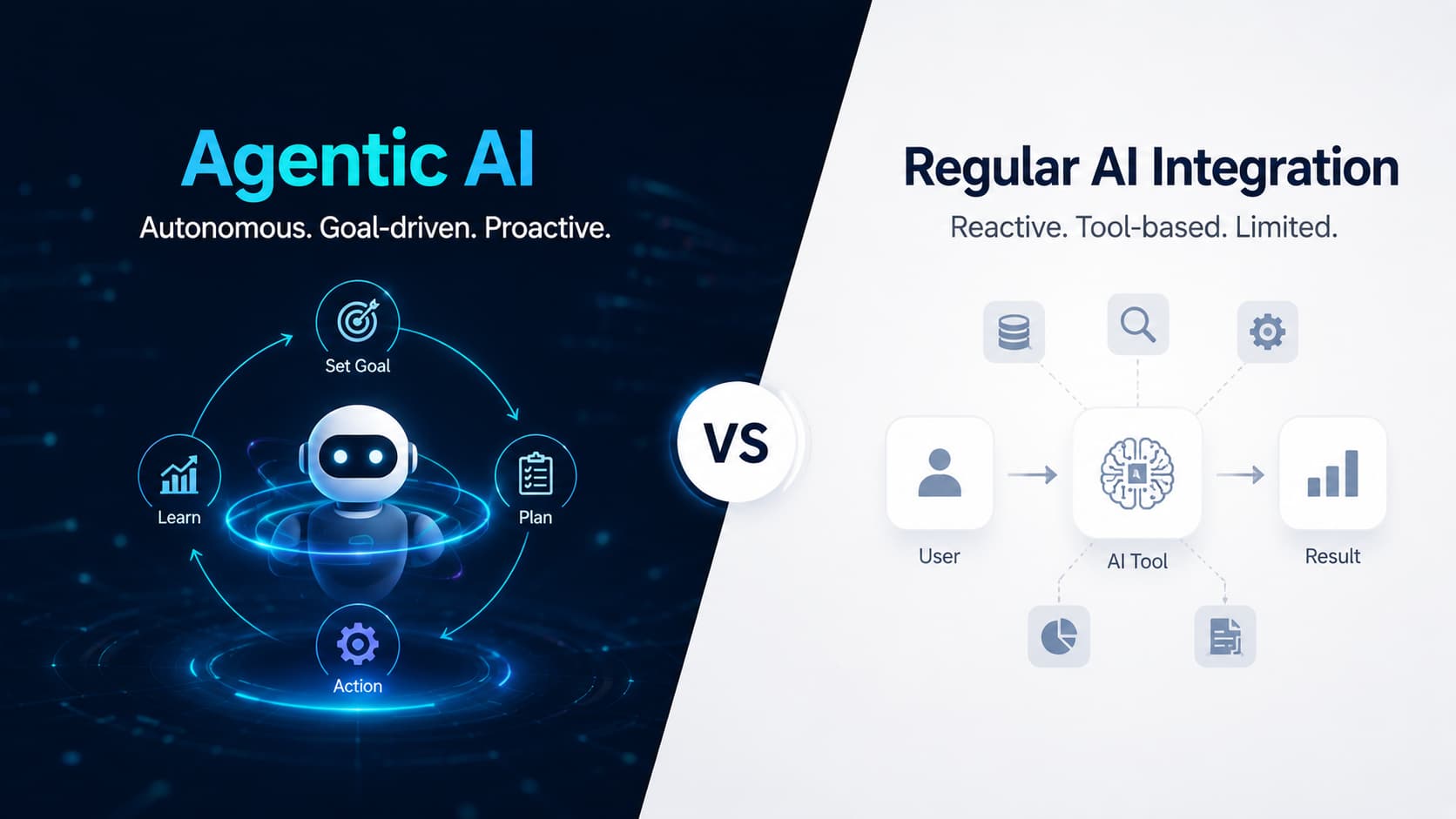
Most AI tools today wait for you to ask something. You type a prompt, it replies, and the task ends there. Agentic AI works differently. It takes a goal and figures out the steps on its own, without waiting for instructions at every stage.
This shift matters a lot for businesses. Companies exploring artificial intelligence development services now face a real choice: build a chatbot that responds, or build an agent that acts. That choice changes how much manual work your team still has to do.
This article breaks down both approaches. You will see clear definitions, a side-by-side comparison, real use cases, and what to check before you adopt agentic AI.
What Is Agentic AI?
Agentic AI refers to systems that can set sub-goals, make decisions, and finish multi-step tasks with very little human input. You give it an outcome, not a script. It figures out the “how” by itself.
IBM defines it as a system built from AI agents that mimic human decision-making to solve problems in real time. That’s a useful way to think about it too.
Here’s a simple example. Say you tell an AI agent to “set up a meeting with the sales team next week.” It checks everyone’s calendar. It finds a slot that works. It drafts the invite and sends it. You never told it which day or time to pick. It decided that part on its own.
What Is Regular AI Integration?
Regular AI integration covers most of the tools businesses already use. Think chatbots, product recommendation engines, and automation scripts. They follow rules someone wrote in advance.
These systems respond to one prompt at a time. A chatbot answers a question, then waits for the next one. A recommendation engine suggests a product based on past clicks, nothing more.
A human still has to direct each step. If something outside the rules happens, the system stalls or gives a wrong answer. It cannot reroute itself. Someone has to step in and fix the path forward.
Key Differences Between Agentic AI and Regular AI
The gap between the two comes down to how much thinking the system does on its own. Here’s where they split apart:
| Factor | Regular AI | Agentic AI |
|---|---|---|
| Decision-making | Follows fixed instructions | Chooses its own next step |
| Task scope | Handles one task at a time | Runs full multi-step workflows |
| Human involvement | Needs a prompt for every action | Needs only a goal to start |
| Adaptability | Cannot adjust if something fails | Changes approach when blocked |
| Tool use | Rarely calls other systems | Calls tools and APIs on its own |
Decision-making is the clearest split. Regular AI does what it’s told, step by step. Agentic AI decides what comes next based on the outcome so far.
Task scope tells a similar story. A chatbot answers a question and stops. An agent can book travel, manage a whole workflow, or close out a support ticket start to finish, no handoffs needed.
Human involvement drops sharply with agentic systems. You’re not typing ten prompts to get one task done. One goal, and the agent runs with it.
This Agentic AI vs AI Agents distinction confuses people because the terms overlap. Agentic AI is the broader system. AI agents are the individual workers inside it, each handling a piece of the job.
Adaptability and tool use round out the list. A script breaks the moment it hits something unexpected. An agent tries a different path, pulls in a new tool, or asks for help only when it’s truly stuck.
Why This Difference Matters for Businesses?
Agentic AI cuts down the manual oversight your team currently spends on repetitive coordination work. Fewer people babysitting dashboards, fewer status-check emails, fewer copy-paste handoffs between tools.
It also handles processes that used to need five separate tools stitched together by a human. One agent can check inventory, update a CRM, and notify a customer, all in one run.
But this comes with more risk, not less. An agent acting across systems with less direct review can make a wrong call faster than a human would catch it. That’s exactly why AI governance has become a bigger conversation inside enterprise IT teams over the past two years. Rules, limits, and audit trails matter more once a system starts acting on its own.
Real-World Use Cases for Agentic AI
A few examples show where this is already working:
- Customer support agents that read a ticket, check order history, and resolve it end-to-end without a human touching it
- Sales agents that qualify inbound leads, score them, and schedule follow-up calls automatically
- Operations agents that watch system logs, spot an issue, and trigger a fix before anyone gets paged
Companies building these workflows often start with a partner offering AI development services, since designing safe multi-step agents takes more planning than a single chatbot ever did.
Things to Consider Before Adopting Agentic AI
Jumping straight to full autonomy is a mistake most teams make once, then regret. A few things to lock down first:
- Define clear boundaries for what the agent can and cannot touch
- Build in human oversight for anything high-stakes, like refunds or contract terms
- Test the agent thoroughly in a sandbox before giving it live access
- Put an AI governance framework in place, with logs and escalation paths
McKinsey’s recent research points out that boards increasingly want risk thresholds and escalation triggers defined before scaling any AI system past the pilot stage. That advice applies directly here.
Conclusion
The core difference is simple once you see it. Regular AI responds. Agentic AI acts. One waits for your next prompt, the other pursues a goal until it’s done.
If your team is still stitching together prompts by hand, it might be worth exploring how agentic AI fits into your existing workflows. Start small, set clear limits, and scale from there.