
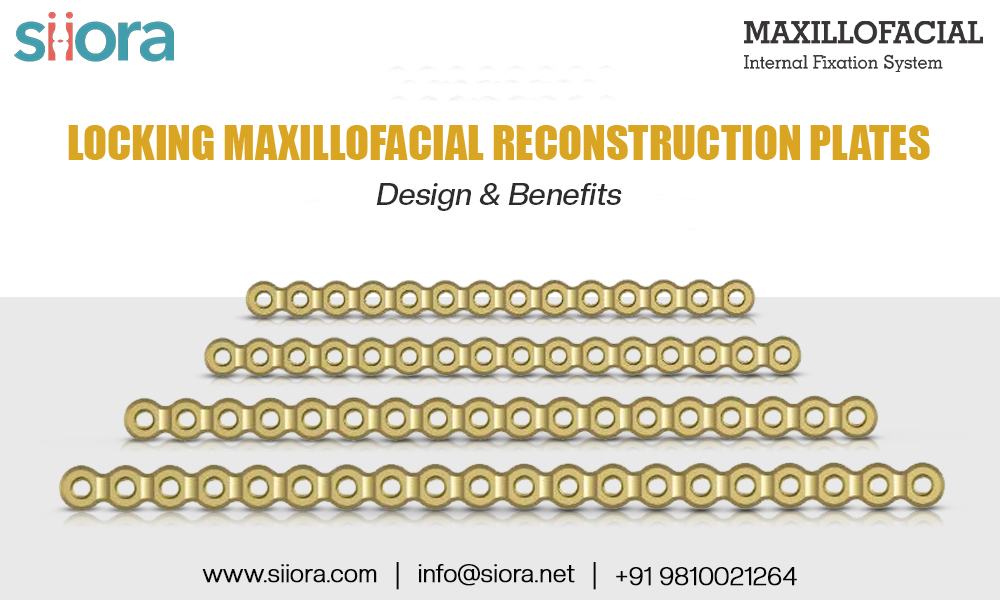
Reconstruction of the facial skeleton is one of the more demanding areas in orthopedic and maxillofacial surgery. The anatomy is complex, the bones are thin in some regions and thick in others, and even small alignment errors can affect both function and appearance. Over the years, reconstruction plates have evolved to provide stronger and more predictable fixation. Among these, locking maxillofacial reconstruction plates have become a preferred choice in many complex cases.
Understanding how these maxillofacial plates are designed and why they perform better in certain situations helps surgeons make more confident treatment decisions.
Basic Design Concept
Traditional reconstruction plates depend on friction between the plate and the bone. When screws are tightened, the plate presses firmly against the bone surface. Stability comes from this compression. While effective in many situations, this method requires precise plate adaptation. If the plate does not sit perfectly against the bone, stability can be compromised.
Locking reconstruction plates work differently. The screws lock into the plate itself through threaded holes. Instead of compressing the plate against the bone, the screw head engages with the plate and forms a fixed-angle construct. In simple terms, the plate and screws act as one solid unit.
This small design change makes a big difference in performance.
Mechanical Stability and Fixed-Angle Support
One of the main benefits of locking plates is improved stability. Because the screw locks into the plate, the risk of screw loosening is reduced. The construct remains stable even if the plate does not perfectly touch every contour of the bone.
This feature is especially helpful in cases of comminuted fractures, bone defects, or segmental resections. In such situations, achieving perfect plate adaptation is not always possible. Locking plates provide angular stability, which helps maintain alignment even under functional load.
For mandibular reconstruction or load-bearing applications, this fixed-angle support is particularly valuable.
Reduced Risk of Screw Loosening
In conventional systems, screw stability depends on the quality of bone. In osteoporotic or irradiated bone, screw purchase may be weak. Over time, micromovements can lead to loosening.
Locking systems reduce dependence on bone quality because the stability comes from the screw-plate interface rather than bone compression alone. Even if the bone is less dense, the locked construct maintains its rigidity.
This can lower the risk of secondary displacement and reduce the need for revision surgery.
Preservation of Blood Supply
Another important advantage is biological preservation. Since locking plates do not require excessive compression against the bone, they minimize disruption of the periosteal blood supply. Traditional compression plating can sometimes interfere with circulation beneath the plate.
Maintaining the blood supply is essential for bone healing, particularly in large reconstructions or trauma cases. Better biology often translates into better healing outcomes.
Ease of Contouring and Surgical Handling
Modern locking maxillofacial reconstruction plates are designed to be contourable. Surgeons can bend and adapt them according to the patient’s anatomy without significantly affecting locking function. Once contoured, the locking mechanism still provides angular stability.
This combination of flexibility during adaptation and rigidity after fixation makes the system practical in the operating room.
Applications in Complex Reconstruction
Locking reconstruction plates are commonly used in mandibular fractures, tumor resections, trauma cases, and deformity corrections. In segmental mandibular defects, they can serve as load-bearing devices while bone grafts heal.
Their reliability in high-stress regions of the face has made them a standard choice in many centers.
Conclusion
Locking maxillofacial reconstruction plates represent a meaningful improvement over traditional plating systems. By creating a fixed-angle construct, they provide stronger stability, reduce screw loosening, and support better biological healing. While conventional trauma implant CMF plates still have their place, locking systems offer clear advantages in complex and load-bearing situations.
For surgeons dealing with challenging facial reconstructions, understanding the design and practical benefits of locking plates can help achieve safer and more predictable outcomes.

