Fixing broken bones has always been about two main goals—getting the fracture stable and allowing it to heal naturally. Over the last decade, one advancement has quietly rewritten how orthopedic surgeons achieve both: variable angle locking (VAL) technology. What started as a small upgrade to traditional locking plates has now become a cornerstone in modern trauma surgery, offering a smarter, more adaptable way to treat fractures that once seemed too complex to repair perfectly.
What Variable Angle Locking Really Means?
Old-school locking plates came with screw holes drilled to a fixed, preset angle. That design worked—strong, predictable, and reliable. But in real life, fractures aren’t tidy lines on a textbook illustration. Bones shatter differently depending on the accident, age, and bone density. Those fixed-angle plates often left surgeons wishing they could tilt a screw just a little to catch a better bone segment or dodge a nearby joint surface.
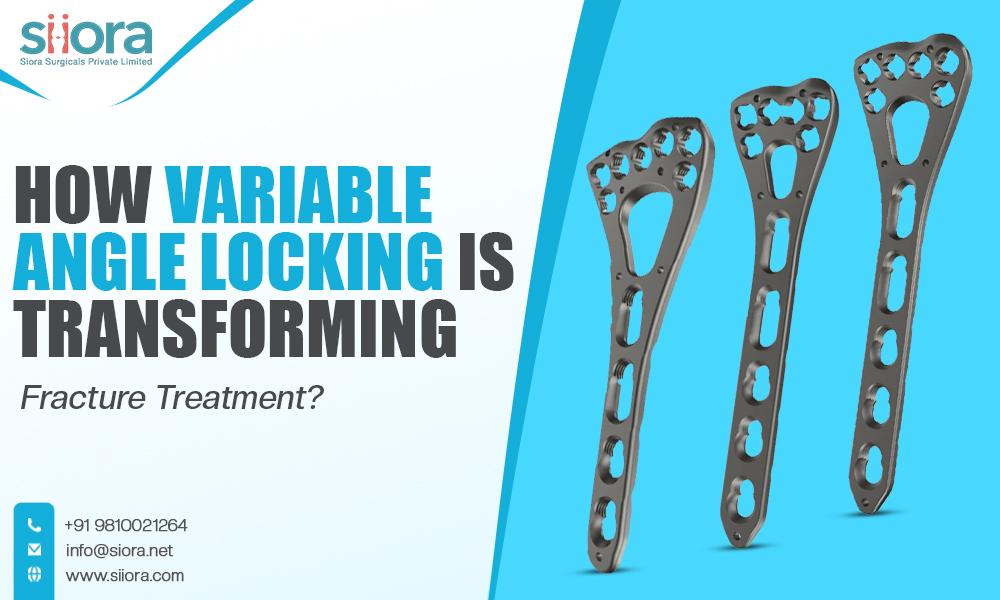
That’s exactly what variable angle locking plates made possible. Each screw hole now has a smooth, conical thread that allows the surgeon to lock screws within a defined “window,” usually about 15–30 degrees in any direction. Once tightened, the screw head locks into the plate just as firmly as a fixed one. In other words, the device still gives fixed-angle stability—but with freedom to find the perfect trajectory.
This balance of flexibility and stability might sound simple, but in the operating room, it changes everything.
Greater Control in Complex Areas
Think of a distal radius fracture near the wrist or a shattered tibial plateau close to the knee. These are small spaces full of tendons, nerves, and varying bone quality. With fixed plates, surgeons were confined to drilled angles that sometimes forced less-than-ideal screw placement. VAL technology eliminates that compromise. Surgeons can thread each screw where the strongest bone lies, steer around an articular surface, or capture tiny fragments that would otherwise go unsupported.
This precision not only improves fixation strength—it protects vital structures around the joint and helps the fracture line heal in perfect alignment. For patients, it means reduced stiffness, cleaner joint contours, and faster return to normal motion.
Stronger Fixation in Weak Bone
Osteoporotic bone—especially in older adults—poses another challenge. It’s porous, weak, and can’t hold standard screws well. The ability to angle screws toward patches of denser bone turns a tricky procedure into a predictable one. Studies using variable angle plates have shown significant reductions in screw loosening and fixation loss, with healing rates better than conventional systems.
The stability of the VAL construct also spreads mechanical stress across the plate more uniformly. This minimizes screw pullout, even when patients start early mobilization—something that’s become standard practice to avoid complications like joint contracture or muscle loss.
Less Invasive, More Efficient Surgery
VAL technology supports minimally invasive approaches because it doesn’t require perfectly flat bone surfaces or wide exposures. The surgeon can make smaller incisions, slide the plate under soft tissue, and still lock screws securely at tailored angles. That means less bleeding, lower infection risk, and shorter time under anesthesia.
Many orthopedic teams report shorter operating times once they get comfortable with the system, since repositioning the plate to find ideal screw paths becomes unnecessary. With fewer adjustments, patients spend less time in surgery and often go home sooner.
Long-Term Gains for Patients
The difference shows up months—and even years—down the line. Patients with variable angle constructs experience fewer trauma implant failures and better joint function in follow-ups. Whether it’s a young athlete with a complex humeral break or an elderly patient with an osteoporotic wrist, outcomes consistently show stronger unions and smoother recovery.
By minimizing soft-tissue disruption and improving alignment, VAL plates lower the need for revision surgeries. That steadiness in healing has made them the go-to choice for periarticular and comminuted fractures, where every millimeter counts.
A Small Change, A Big Step Forward
The genius of variable angle locking lies in its simplicity. It takes everything surgeons loved about fixed-angle plates—the stability, the rigid fixation—and adds just enough freedom to adapt to real human anatomy. The technology essentially hands control back to the surgeon instead of the implant.
Today, VAL systems are used across the body—from the wrist and shoulder to the knee and ankle—and they’ve quietly raised the standard for fracture care everywhere.
For patients, that means fewer complications, faster mobility, and bones that heal stronger and straighter than ever before.