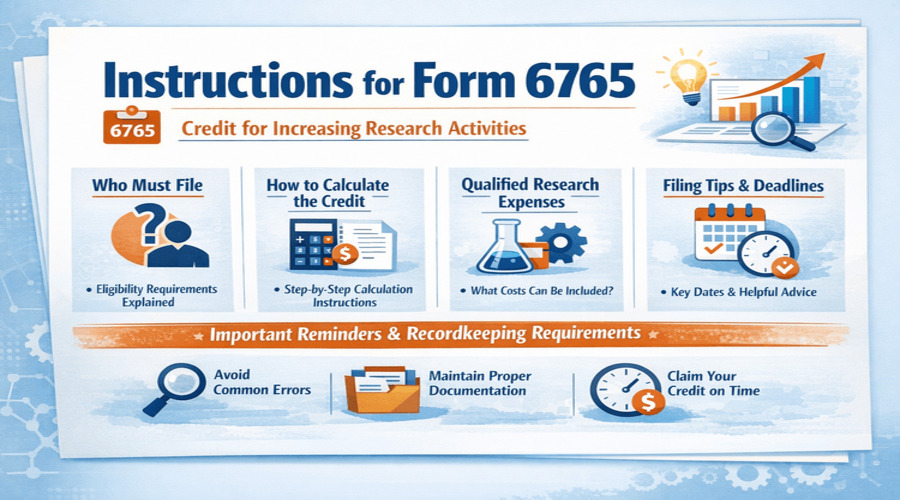
Form 6765 instructions guide businesses to claim federal R&D tax credits, calculate qualified research expenses, select the right method, and reduce income or payroll taxes accurately in 2025.
Table of Contents
- Introduction to IRS Form 6765
- What Is Form 6765 Used For?
- Who Qualifies for the R&D Tax Credit?
- Understanding Qualified Research Expenses (QREs)
- Structure of IRS Form 6765
- Regular Credit vs Alternative Simplified Credit
- How to Calculate ASC vs Regular Method
- Step-by-Step Form 6765 Instructions
- Documents Required to Support Form 6765
- Can Startups Use the Payroll Offset?
- What Changed in Form 6765 Instructions 2025
- Common Mistakes to Avoid
- Why Accurate Filing Matters and Financial Literacy
- How BooksMerge Supports R&D Credit Claims
- Conclusion
- Frequently Asked Questions
Introduction to IRS Form 6765
Innovation comes at a cost. The IRS offers a reward in the form of the R&D tax credit, allowing businesses to recover part of their research expenses. IRS Form 6765 instructions explain how to claim this credit legally and efficiently.
Filing Form 6765 may look complicated at first, but it’s essentially a structured way to tell the IRS, “Hey, we’re innovating, and here’s the cost to prove it.” With clear guidance, even small businesses can maximize their benefits.
What Is Form 6765 Used For?
Form 6765 is used to claim the federal Research and Development (R&D) tax credit. Businesses attach this form to their federal tax return to:
- Reduce income tax liability
- Offset payroll taxes for eligible startups
- Claim credits for innovation and experimentation
Accurate filing ensures businesses receive the credit they deserve while staying compliant.
Who Qualifies for the R&D Tax Credit?
You don’t need a high-tech lab to qualify. Businesses may claim the credit if they:
- Develop or improve products, processes, or software
- Face technical uncertainty in the project
- Conduct experimentation to overcome challenges
- Use engineering, computer science, or other technical expertise
Manufacturers, software firms, architects, and even food developers often qualify. The size of your company doesn’t matter; eligibility depends on activity, not revenue.
Understanding Qualified Research Expenses (QREs)
QREs are the expenses that qualify for the R&D tax credit. Without properly identified QREs, the credit can’t be claimed.
Common QREs include:
- Employee wages dedicated to R&D
- Supplies consumed in research
- Contract research paid to third parties
- Cloud computing expenses tied to development
Non-qualifying expenses include market research, routine testing, or cosmetic design work. Proper documentation ensures your claim stands up to IRS review.
Structure of IRS Form 6765
Form 6765 contains multiple sections designed to cover various taxpayer situations:
- Section A: Regular Credit Calculation
- Section B: Alternative Simplified Credit (ASC)
- Section C: Current Year Credit
- Section D: Payroll Tax Election for Startups
The instructions for Form 6765 help you determine which sections apply based on your business type and revenue history.
Regular Credit vs Alternative Simplified Credit
Choosing the right method can significantly affect your credit.
Regular Credit Method
- Based on historical base amounts
- Requires extensive data from previous years
- Often higher for established businesses
Alternative Simplified Credit (ASC)
- Uses three-year average of QREs
- Easier to calculate
- Popular among small and mid-sized businesses
According to IRS guidance, most companies prefer ASC for simplicity and accuracy.
Quick Tip: Learn how to fill out a 1040 form step by step to report income, claim deductions and credits, and file your federal taxes accurately and confidently.
How to Calculate ASC vs Regular Method
ASC calculation: 14% of current-year QREs exceeding 50% of the average QREs from the previous three years.
Regular method: Multiply the historical base percentage by average gross receipts.
Businesses often calculate both and choose the method that provides the higher credit. This ensures maximum benefit while complying with IRS rules.
Step-by-Step Form 6765 Instructions
Here’s a simplified filing workflow:
- Identify eligible research activities
- Calculate total QREs
- Choose ASC or regular method
- Complete the relevant sections
- Transfer credit to Form 3800
- Attach Form 6765 to your tax return
Accuracy is critical. Errors or omissions can trigger audits or delay refunds.
Documents Required to Support Form 6765
The IRS expects robust documentation to support all R&D claims:
- Payroll records for employees performing R&D
- Project descriptions with timelines and objectives
- Time tracking for research activities
- Expense invoices, receipts, and contracts
Can Startups Use the Payroll Offset?
Yes. Qualified small businesses can use up to $500,000 of the R&D credit against payroll taxes.
Eligibility:
- Gross receipts under $5 million
- Less than five years of gross receipts
This helps startups conserve cash while still benefiting from innovation incentives.
What Changed in Form 6765 Instructions 2025
Key updates in 2025 include:
- Enhanced disclosure requirements for research activities
- Stricter IRS review of software development claims
- Section 174 compliance regarding amortization of R&D expenses
These changes ensure transparency and reduce errors, improving the quality of claims submitted to the IRS.
Common Mistakes to Avoid
Even experienced businesses make mistakes:
- Overstating QREs
- Skipping required schedules
- Choosing the wrong credit method
- Forgetting payroll tax elections
Using a completed Form 6765 example can prevent errors and streamline filing.
Why Accurate Filing Matters and Financial Literacy
Correctly following Form 6765 instructions doesn’t just secure a tax credit. It:
- Improves financial decision-making
- Supports better forecasting and budgeting
- Ensures compliance and audit readiness
Accurate records build business trust and long-term financial stability.
How BooksMerge Supports R&D Credit Claims
BooksMerge helps businesses navigate Form 6765 instructions with confidence:
- Identifying qualifying research activities
- Calculating QREs accurately
- Choosing the optimal credit method
- Maintaining documentation to withstand IRS review
Good recordkeeping also enhances business financial literacy. Companies with well-maintained R&D records often make smarter investment decisions. Check insights here: financial literacy statistics
Call +1-866-513-4656 for expert assistance in claiming the R&D tax credit efficiently and accurately.
Conclusion
Form 6765 instructions are your roadmap to claiming federal R&D credits. By calculating QREs correctly, choosing the right method, and maintaining clear documentation, businesses can maximize tax benefits.
Innovation deserves recognition, and the IRS provides it. Proper filing ensures compliance, financial efficiency, and peace of mind.
Frequently Asked Questions
1.What is Form 6765 used for?
Form 6765 claims the federal R&D tax credit, reducing income or payroll taxes for businesses investing in innovation.
2.Who qualifies for R&D tax credit?
Businesses performing qualified research involving experimentation and technical uncertainty in science or engineering may qualify.
3.What are QREs?
Qualified Research Expenses include wages, supplies, contract research costs, and cloud computing expenses tied to R&D activities.
4.How to calculate ASC vs regular method?
ASC uses a three-year average of QREs; the regular method uses historical base percentages. Calculate both and choose the higher credit.
5.What documents are required?
Payroll reports, project documentation, time tracking, and invoices are required to substantiate Form 6765 claims.
6.Can startups use payroll offset?
Yes. Eligible startups can offset up to $500,000 in payroll taxes using the R&D credit.
7.What changed in 2025?
Form 6765 instructions 2025 include stricter software R&D review, enhanced disclosure, and Section 174 compliance updates.
Read Also: Form 6765 Instructions
For professional assistance with Form 6765 instructions, contact BooksMerge at +1-866-513-4656 and maximize your R&D tax credit.